
No Bad Parts: Psychology, Spirituality & Coming Home to Yourself
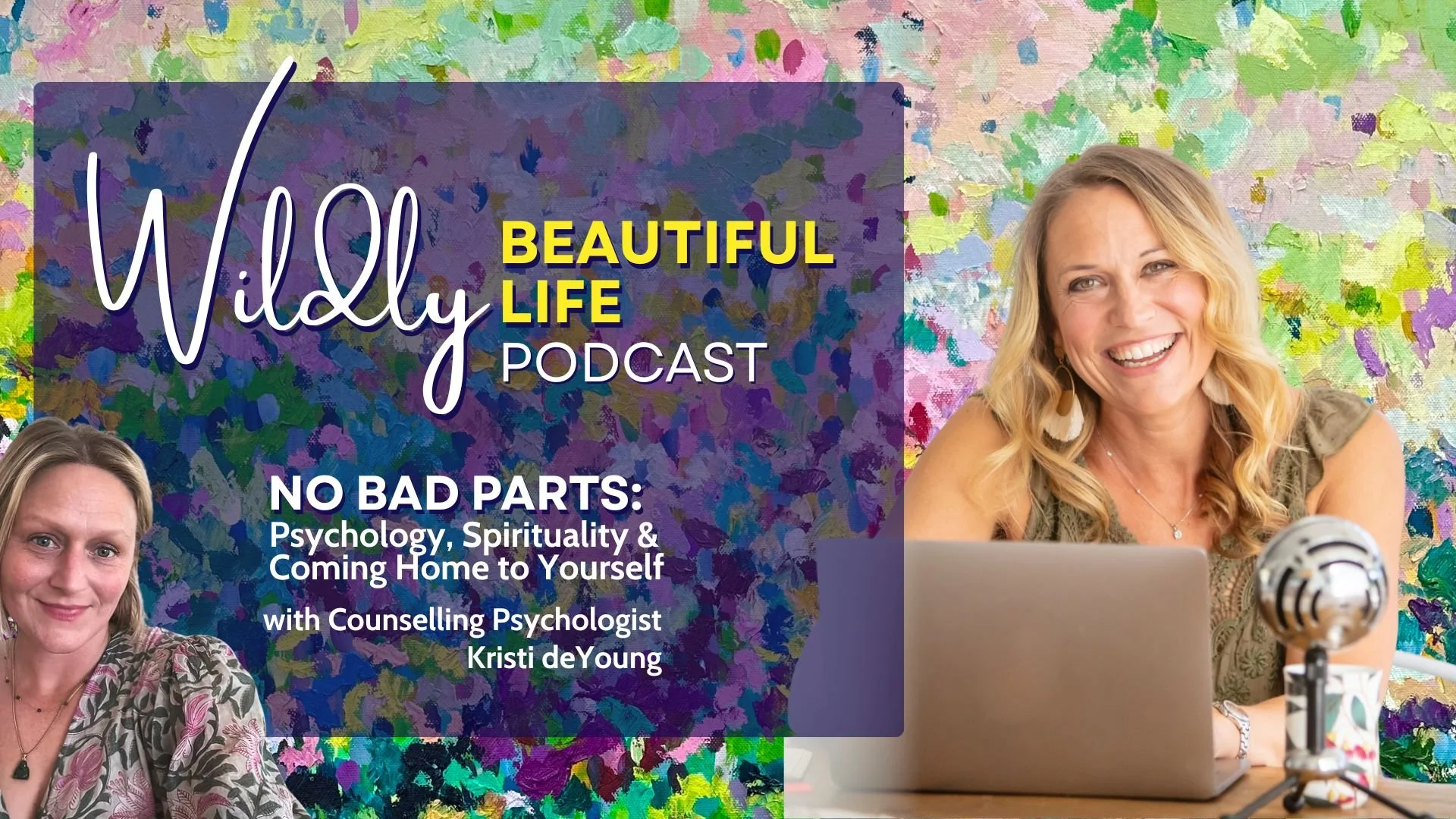
Psychologist Kristi De Young on the inner boardroom, exiled parts and becoming whole
Have you ever said, “A part of me wants to go, but another part wants to stay home”? Or felt genuinely excited about a new direction while another voice warns you not to risk it?
We often speak this way without thinking about it. Yet the language reveals something important: we are not as singular as we have been taught to imagine.
In my conversation with counselling psychologist Kristi De Young, she offered a wonderfully simple metaphor for understanding this inner complexity. Imagine your psyche as a boardroom. Around the table sit the many parts of you: the confident one, the anxious one, the caretaker, the achiever, the perfectionist, the part that wants adventure and the part that wants certainty.
None of these parts is inherently good or bad. Each has a history, a purpose and a perspective. The more revealing question is not only who is sitting at the table, but who has not been allowed into the room.
The parts we exile
Kristi’s work draws strongly on Internal Family Systems, a therapeutic model developed by Dr Richard Schwartz. IFS recognises that we each contain different parts and that, beneath them, there is a deeper core Self capable of curiosity, compassion, courage and connection.
Some parts take on powerful protective roles. A perfectionist may try to prevent criticism. A people-pleaser may work constantly to preserve belonging. An anxious planner may believe that if it anticipates every possible danger, nothing painful will catch us by surprise.
Other parts are pushed away because they once felt unsafe or unacceptable. Kristi refers to these as our exiled parts. They may carry sadness, anger, sensitivity, imperfection, need, creativity, spirituality - or simply a younger self who learned that making a mistake had consequences.
Kristi gave the example of a child who was embarrassed after failing a test. Decades later, an adult can still be triggered by the possibility of making a mistake and suddenly react with the fear of that seven-year-old. The adult has accumulated years of evidence that mistakes are survivable, but the younger part has not yet received that update.
Remember when Will Smith punched Chris Rock (after he made a joke comparing Will’s wife (Jada Pinkett Smith - who has alopecia - to Demi Moore’s character in G.I. Jane).
That was a real time example of an unresolved childhood trigger causing an instantaneous, explosive reaction. (In his memoir, Will, and subsequent interviews, Smith revealed that as a young boy, he watched his father abuse his mother. This created deep-seated trauma, leading Smith to harbor feelings of inadequacy, fear, and a compulsive desire to protect the women in his family from the kind of vulnerability he witnessed in his childhood.
So while we can’t excuse Will’s reaction, we can compassionately understand where it stemmed from.
And we can recognise that we, too, have unresolved childhood triggers - even if they aren’t quite so publicly experienced. For every hysterical reaction we have - we can pretty much be assured, it’s historical.
As Kristi reminds us, healing is not about shaming the perfectionist into silence. It is about understanding why that part took over and making it safe enough for the imperfect younger self to come back into the room.
Remembering who you were before life happened
One of Kristi’s most beautiful descriptions of therapy was that she helps people “remember who they always were before life happened to them.”
This does not mean returning to an untouched or idealised version of ourselves. It means recognising the deeper essence that remains present beneath the strategies, stories and social conditioning we accumulated in order to belong and survive.
This is also where Kristi’s work connects so naturally with mine.
I often use astrology, Human Design and Gene Keys as reflective languages for understanding the many energies within a person. An astrological chart is circular, like Kristi’s boardroom, and every planet and sign carries a different voice. One part wants stability. Another wants reinvention. One wants to analyse. Another wants to leap.
The aim is not to remove the tension and become one flat, perfectly consistent person. The aim is to become conscious of the voices at the table and to let our wisest Self chair the meeting.
Healing must feel safe enough
Welcoming an exiled part home is gentle work. Kristi emphasised that therapy is not about dragging someone into the most intense version of a feeling. Safety is built gradually and includes attention to what the body can hold.
Sometimes a person might imagine inviting a feeling in at five out of ten rather than ten out of ten. Somatic practices like havening (such as placing a hand on the heart or using soothing touch) may help the nervous system recognise that the present is different from the past.
This distinction matters. Insight alone does not always update the body. We can logically know we are safe while a younger part remains braced for what once happened. Compassionate pacing allows the whole system to learn: I can feel this now, and I do not have to face it alone.
When psychology and spirituality share the room
Kristi began her career with conventional psychological approaches and gradually moved towards a more integrative practice. Her interest in existential, Jungian and transpersonal psychology opened questions beyond symptom management: Why are we here? What creates meaning? What helps a person feel connected to life?
Rather than prescribing a belief system, Kristi invites clients to explore what genuinely resonates for them. In our conversation, she described laying possibilities out like a buffet and allowing each person to decide what belongs on their plate.
That freedom matters. Many of us inherited a fixed book of beliefs before we were old enough to question it. Becoming aware and of autopilot allows us to ask: Is that my belief - or one I learned? What do I now choose to understand for myself?
I shared how my own upbringing initially shaped a narrow understanding of what was possible. Exposure to different interpretations and traditions did not immediately give me a new set of answers; it gave me permission to become curious. Difference no longer had to mean danger. My world grew larger.
The exhaustion of compartmentalising yourself
Kristi also spoke candidly about her own decision to become more visible - not only as a psychologist, but as someone interested in tarot, astrology, spirituality and the mystery of being human.
Previously, she had compartmentalised these different parts. Bringing them together has felt far more easeful: less masking, less pretending and less energy spent managing who is allowed to see what.
The result has not been rejection. It has created more honest conversations and allowed aligned clients and colleagues to recognise her. One colleague saw how openly she shared her spiritual interests and said, “I didn’t know we were allowed to be that.”
That line holds the ripple effect of authenticity.
When we stop hiding, we do more than liberate ourselves. We expand what appears possible for the people watching. Our willingness to say “this is me” can become another person’s permission slip.
Four relationships that support a meaningful life
Drawing on Jungian analyst James Hollis, Kristi described four relationships that contribute to a meaningful life:
1. a relationship with ourselves;
2. a relationship with community;
3. a relationship with the environment or natural world; and
4. a relationship with something transcendent - something beyond the individual self.
These relationships are not luxuries to earn after we have completed every obligation. They are part of what makes a life feel alive.
When someone feels lost or depressed, Kristi may explore where connection has thinned. Has the person become estranged from herself? Is she isolated from community? Has she lost contact with nature? Is there no sense of meaning or participation in something larger?
There is no single approved answer to the transcendent question. There are many rivers leading towards the ocean. The work is to find the path that is true for you.
Trust yourself - and trust your capacity to cope
At the close of our conversation, I asked Kristi what she most wanted a young person to know.
Her answer was twofold: trust yourself deeply enough to know what is right for you, and trust that you have the capacity to cope.
The path that is true for you may not make logical sense to everyone around you. It may challenge family programming or inherited expectations. That does not mean the inner knowing will disappear. You can postpone listening, but the truth often keeps returning.
Perhaps that is the invitation of this entire conversation: not to silence the inner boardroom, but to listen with greater discernment. Not to exile the frightened or imperfect parts, but to let them know that they are no longer alone. Not to perform a version of yourself that everyone understands, but to become whole enough to be recognised by the people who are meant to find you.
Who is sitting at your inner boardroom today?
And who is still waiting outside the door?
Or - if you prefer video, you can watch it here:
To learn more about Kristi, visit her website: https://www.kdypsych.com.au/
or find her on Instagram at https://www.instagram.com/kristideyoungpsychology/.
& if you haven’t already begun exploring your own inherent design, download my free Align & Shine Energetic Blueprint at https://www.annmariegrace.com/unique.